In the new normal, no one can hear you scream

615Jt--UndL._AC_SL1024_.jpg

When Ridley Scott’s masterpiece Alien was released in 1979, the poster featured an alien egg cracking open, with an eerie light and mist.  It was a great poster image, but even better was the small tag line below: “In space no one can hear you scream.”  With extraordinary brevity, Scott exploded the vogue for science fiction movies as heroic, thought-provoking and pretentious (Star Wars, Close Encounters, 2001) and suddenly made the genre stark, claustrophobic and terrifying. In Scott’s universe there are vast worlds to mine and new life-forms to be discovered at the very fringes of humanity’s reach.   But when those life-forms inevitably decide to kill you; in a vacuum, no one will hear your shouts for help, or your cries for mercy.  And it was with that same sense of desperate isolation that I screamed unherd, while watching The Bundesliga on TV this week.

Behind closed doors is apparently par for the course in the “new normal”.  Inspired by the German trailblazers, sportsmen and women around the world are now psyching themselves up, dropping and giving twenty, in determined preparation for competing behind closed doors. They’ve done the Corona tests, been cleared, or have cheered as the antibodies are confirmed, and they are headed alone to some anonymous outpost at the far end of the known universe [some ‘neutral’ disinfected venue], to play for us in splendid isolation.  Watching the Bundesliga players, celebratory high-fives and kisses were replaced with elbow bumps which could actually be heard, while the great unwashed crowds were locked out.  The players looked bored and forlorn, while their uptight support staff stood stoically in designer snoods and $100 face-masks. 

There is talk of the theatre, of live music, of even opera going the same way.  Artists will be able to come out of the shadows, to co-locate nervously and perform, as if released like creative phoenixes, to grace the stage again, while sealed behind doors. If policy makers insist (and all opinion polls seems to suggest we want to be guided by their insistence) then the architects of the new normal will do all they can to replicate the great gatherings of the past (remember full stadiums yelling, Glastonbury flags obscuring and theatre stalls laughing?) but with audiences cocooned away from the alien virus. The Masters golf is to be re-scheduled in a manicured Hunger Games style quarantined course.  Royal Ascot will go ahead, but without Royals, or lascivious wassails swaying, unstable in high heels.  Formula One racing will still be noisy, but as in Ridley Scott’s horror, there will be no one to hear the engines scream. 

Which brings me to another great form of gathering - higher education, and its more grown-up cousins, business or executive education.  The profession has none of the glamour of the movies, or the pulse raising thrills of sport. We occasionally use music, but more to make a point, or signal a change of mood, than to truly lift the soul in the way a great gig or concert can do.  But my fear is that higher and business education may head the same way as the Bundesliga. Policy makers’ timidity will mean School estates staff are compelled to erect plexiglass screens to divide mask-muffled lecturers from sparsely allocated students, as the only way of making classes “safe.” The more cautious still will default wholly to virtual broadcast lectures and Zoom seminar groups and no collective breathe will be risked in the transmission of valuable thoughts and ideas.

It has already begun in the primary and secondary sectors.  We have had two decades of parents’ perennial fight to wrestle their children’s gaze away from the screen of the Xbox, the Playstation or their iPhone.  Now the new normal for the best provided for kids, is to sit for hours with an iPad, or laptop connected to some disembodied remote teacher. And the outcome sought by this endeavour?  Yes, you might win a place, paying over £9,000 a year, to experience the same online with Cambridge University or Manchester. It seems the zenith of educational experience will be to provide something that is “not too bad”.  So, not a life-enhancing experience that challenges the way you think, or the chance to meet your life-partner, or even, the possibility of discovering yourself. No, the ambition of the new normal seems to be, like football behind closed doors, to make it “not too bad”.  

Unless the policy makers change their guidance, then the safety first approach of large cohort education will end up having all the thrills of Bill Clinton’s famous marijuana defence: yes, we say we smoked some at university, but we certainly did not inhale.  The purified air we breathe will be all ours and the familiar walls will remain unchanged as we supposedly learn and grow.  Students in the near future will watch great Campus films like Everybody Wants Some, or Animal House, or Goodwill Hunting and simply not believe it was like that.  

And if you dare tap them on the shoulder while they are watching, they will instinctively flinch and scream.

In A World of Pandemic – what we can learn from cinema

3ecf2b31e70e7f60dfa1d17da4ffa1f521dc747f.jpg

While many sectors have felt the devastating impact of disruption in recent months, the motion entertainment industry, might just have built enough innovation and resilience into its model to survive.  

Rather than being cornered into a knee-jerk reaction and sudden pivot to digital; the content producers still earn revenues through sophisticated global digital distribution platforms. Netflix, Apple TV, Hulu, Disney Plus, Amazon Prime have all benefited from a global lockdown: as we’re stuck at home and hungry for content and distraction. Meanwhile, live music and ‘higher-brow’ alternatives like drama, musical theatre and opera, are scrambling to earn any revenues in a YouTube world where “everything is already free”.  

It’s not all positive for content creators.  A long production freeze will be costly and focus the minds of all players (though New Zealand may benefit from an early opening of facilities) and there is already a dearth of new content.  Movie theatres are in big trouble and some are spoiling for a post-Corona fight with Studios, some of whom provided new titles hastily to online audiences.  But subscription platforms have been overwhelmed with demand; so much so that Netflix throttled streaming quality in Europe.  

The seeds of resilience were sown in the past    

Picture the scene.  Hollywood, California.  The year is 1919.  The halcyon days of black and white silent movies.  A group of ambitious film actors and directors, including Charlie Chaplin and Mary Pickford, launch a new venture called United Artists (UA). Their disruptive idea was to let actors control their own interests, rather than being wholly tied to commercial studios and from that idea UA was born.  In the 100 years since, UA has been bought, sold, restructured and renamed numerous times, but still, some ten decades later (including a brief interlude being owned by Tom Cruise) it continues in a new form as United Artists Releasing.  Today UA is a digital IP distribution vehicle, creating exclusive online content for Walmart’s ‘Vudu Movies on Us’ service.  In an industry repeatedly confronted by change and disruption, it is a remarkable tale of evolution, adaptation and survival.   

But more remarkable is that UA is not alone.  While the Studio mega-mergers have shrunk their numbers, Hollywood’s production slates remain chalked with familiar brand names (Warner Brothers, Paramount, Universal, Disney) that have somehow survived, in one form or other, for a century or more; producing moving pictures, distributing entertainment, making stars and creating box office.  Behind this there are numerous stories, like that of UA, which began with smart innovation and grew from there. 

In the same year that Chaplin signed with United Artists, a few blocks away, Harold Lloyd began holding “test screenings” of his films and modifying them based on audience feedback, a practice which continues today. Across town, William Fox, founder of Fox Film was busy building cinema houses and investing in a new concept called “sound on film”.  But disruption reared its head and following the Wall Street Crash, Fox merged with Twentieth Century Pictures to form 20th Century Fox.  This new Fox survived World War II, before thriving as cinema audiences grew globally and was acquired by Rupert Murdoch in 1985.  In March 2019, 100 years after Chaplin and Fox were pitching ideas and production technologies, 20th Century Fox was sold by Murdoch to The Walt Disney Company for around $70 billion; the biggest deal in the history of motion entertainment. After 100 years the Fox was finally consumed by a Mouse.  

The future is happening faster

Such longevity is perhaps not normally associated with “creative” industries, but creativity seems to have built in more resilience than we might imagine.  Disruption, innovation, new technology, digitisation, societal change and globalisation have meant a continual process of formation and destruction, impacting whole industry sectors, renowned brands and business giants. To illustrate, of the Fortune 500 companies first listed in 1955, some 90% of them no longer make the list today.   

Every decade in the last hundred has had its share of seismic shocks, those ‘black swan’ moments with devastating outcomes for businesses regardless of their stature.  The health consequences of the COVID-19 pandemic are already quantifiably terrible; the economic consequences are predicted to be devastating for a whole generation.  But was this sudden dramatic impact on some businesses so wholly unpredictable?  Did the pandemic just dramatically hasten the inevitable to happen?  Before we had heard of COVID-19, was the sheer bloody-awfulness of budget air travel really the zenith of human innovation?   Was standing in a muddy field queueing for a portacabin toilet the highpoint of a music lover’s life?  Was travelling for weeks cocooned on a crowded Cruise liner ever really that great?  Did footballers really need to be paid £300,000 a week?  

Invest in both online and offline 

50 years after Chaplin made The Gold Rush for United Artists, a building in Toronto housed the world’s first iMax cinema, providing what would become both a glimpse of the future and the summit of the past of theatrical experience. But innovation did not end there. In this century, the traditional studios and theatres, bolstered by new audiences and the vast dollars of its digital platform providers, has meant investment in BOTH analogue and digital distribution.  If you went to a cinema in the UK just fifteen years ago it was a pitifully tired experience.  Sticky floors, smelly toilets, predictable programming and underwhelming sound and visuals.  There has been a renaissance in cinema going that has mirrored the growth in on-demand digital offerings.  Now you have choice: retro-chic at boutique Picture house, 24-hour venues, free-parking, drinks, film clubs, high-definition sound, 4D experiences.  If you want to pay more, there are extraordinary iMax 3D venues and the “Lux” offerings with comfy sofas, waiters and fine dining.  A huge change from the ABC I knew growing up!  In the past 50 years, the industry has built both the nuclear bunker (global digital distribution) and still created new pleasure domes (great new theatres) at the same time.  The strategic lesson is that cinema saw digital disruption as both an opportunity and a threat.  Being imaginative in its response to both has proved to be its saviour.     

Some hope from the past 

When Chaplin launched UA, it was only twelve months after the first spring outbreak of the 1918 Influenza Pandemic and the world was still at war.  Just as today in 1918, movie theatres in the US were forced to close.  Many smaller film companies went out of business and production was halted, as there were no theatres open for audiences – and clearly, in 1918, Hollywood did not have a global digital distribution platform to weather the storm. Some commentators doubted if the cinema would ever have a future.  But post-pandemic and post-war, the actors and directors and producers and their investors became re-aligned around a few powerhouse Studios. By being newly refocused on a new audience appetite for extraordinary storytelling and armed, first with sound, then with colour, the Golden Age of Hollywood was born.  

Which made me wonder, how many industries today will draw upon a post-Pandemic wave of pent up demand, not just re-start their business, but to transform it in ways that make it resilient for the future?    

Nostalgia, not hope, is the key to life after lockdown

 “The past is a foreign country. They do things differently there”. E.M. Forster

DAVID BOWIE - A MAN FROM THE FUTURE, SENT INTO THE PAST TO INSPIRE US TODAY

DAVID BOWIE - A MAN FROM THE FUTURE, SENT INTO THE PAST TO INSPIRE US TODAY

When will it end? When will life go back to normal again? All our hopes seem to be pinned on the prospect of emerging from a locked-down world and that world looking a lot like it did before.  Remember, like it was before everything went mad!?  It won’t, but that doesn’t mean that the feelings are any less potent.  So, we naturally cling to hope.  But this time our hopes for the future aren’t progress, or difference, or improvement, or even new shiny things. Perhaps for the first time in history, the whole world now longs for the future to be a return to the past.  

Speak to a close friend. Well, any male friend - and say words like “football”, “pub” or “gig” and even via the low latency of a laptop webcam, you can instantaneously see his face twitch, as a powerful neurological and physiological reaction takes hold. Such is the depth and complexity of the human mind that he processes the aurally received concept of a “Pub”, he pictures, considers, reflects, processes and responds (in less time than it takes a Wuhan wet-market bat to flap its wings) and he says something at once relatable and universal. “Fuck yeah, can you even imagine!?”

And we can. We can picture every moment. Heading west on a cramped sweaty tube, shouting above the noise, paying a fiver for each pint, the aggro at closing time, the fights, the stupid messages, the artery swelling junk-food, the cab driver sharing his ‘wisdom’, the hangover, the inevitable alarm clock, the mouthwash, the paracetamol, the weary commute on the familiar journey to a workplace surrounded by other people.  Some of our deepest future hopes are for a rerun of evenings we might at best only half-remember.   

“Nostalgia.  It’s delicate, but potent.”  Don Draper, Mad Men.  

Today is, I think, the 40th day of lockdown. I have been listening to Aladdin Sane.  Bowie’s sixth studio album was released 47 years ago. Forty-seven years!  An age away. And it’s still timeless and idiosyncratic and uncomfortable - a smorgasbord of piano (and what a piano!) and scribbled words, schizophrenically switching styles between haunted moodiness and singalong choruses and then some head-down guitar riff driven boogie.  I hear it again and feel instant nostalgia. 

I can remember listening over and over to the album a few years after it was released. In the late 1970’s I lived in Warley Drive, Bradford and Bowie’s was one of a handful of records I actually owned.  Where I lived was a bit shit. I’ve only been back to that street once in four decades. I have zero nostalgia for that time or place. T’was grim. A lot of what made that past memorable was probably best forgotten.  Perhaps it’s part of the reason that Aladdin Sane still sounds so wonderful today? But I don’t long to return to that past, even for an album that sometimes skipped on side two.    

“The future, isn’t what it used to be.” Foals, Black Gold.

We’re rightly bamboozled by the uncertainty of the future (which may indeed again be “a bit shit”) and hold ever tighter to the deeply felt memories of the past.  In Mad Men, Don Draper said the feeling of nostalgia was like the “pain from an old wound.” What then does pre-Corona nostalgia look and feel like? Is it a longing for Family? Friends? Work? Music? Theatre? Italy? Sport? Because the good news is that in the future that feeling of nostalgia and wonder will still be there - in the locker of the past. On the Zoom backdrop bookshelves of yesterday.  And whatever the triumphs and tragedy ahead, it will be found again in a post-Corona world. That nostalgia will still be there. 

Surviving in a world of Virtual Presence

There is a new game to play while clinging on to what remains of the Corona disrupted corporate ladder.  It’s called Virtual Presence. 

This new game requires you to show up, right on time, suitably focused and ‘dressed-down’, but with a witty virtual background and some well-prepared smarts about the new “paradigm” you/your family/your industry/the world, is facing.  Locked at home you have few legitimate excuses to not attend, so you amuse yourself swapping gallery views, screen sharing, getting lost in breakout rooms.  You remain bemused that the “touch up my appearance” setting on Zoom does, erm, nothing that helps.  But as always, some clues to navigating the new chores of a disrupted future lie in the inspirational heroes of the past.   

In 2013 a software developer called “Bob” made global headlines, demonstrating a level of commercial ingenuity that still inspires many to this day.  Bob earned over $100,000 a year, spending his workdays at Verizon surfing the web, watching videos on YouTube and browsing Reddit and eBay, while he “outsourced” his day job to someone in Shenyang, China to actually do the role for him.  His bosses were happy to see his extraordinary productivity and the long hours he committed to his role.  Using nothing more sophisticated than a VPN connection and a healthy dose of imagination, Bob reportedly paid just a fifth of his six-figure salary for someone else to write his code.  He continued the ruse for several years before an IT audit stumbled upon his “workaround” and his hero status amongst software developers was firmly secured.    

Just this week in a Corona-disrupted world of lockdowns, social distancing and virtual meetings, a new hero has emerged to build on Bob’s legacy.  For about a week the business world collectively embraced Zoom as a smart way of staying connected with work, but then it morphed into something else.  Employers started bombarding workers with non-stop video meetings, or “check-ins”, then virtual happy hours, speed networking, collaborative yoga and quiz nights.  Exhausted by having to virtually “show-up”, Matt Reid a technologist in Nashville, came up with a brilliant workaround, building a "Zoombot" to double as his doppelgänger on Zoom.  

In just one morning, Reid recorded himself in Quicktime, looking quizzical, confused, opening his mouth, and smiling, and took some screenshots. When these images cycle through, it almost looks like Reed has a poor connection—and he programmed his bot to say as much.  His AI doppelgänger is a little slow to respond, it doesn't really blink, and it uses an open source voice response system similar to Siri or Alexa, so Reid now sounds British!  While out for a walk, or taking an afternoon nap, he can still be seen to be virtually joining Zoom using a piece of software that sets up a virtual webcam rather than an actual live feed coming through the lens.  Better still, his innovation is open source on GitHub and other developers around the world are busy developing and refining the solution.  

Even Bob and his colleague in Shenyang would be impressed. 

Matt Reid story, originally sourced from “Popular Mechanics”, April 2020 written by Courtney Linder


The future looks back at you and grins inanely

IMG_2106.jpeg

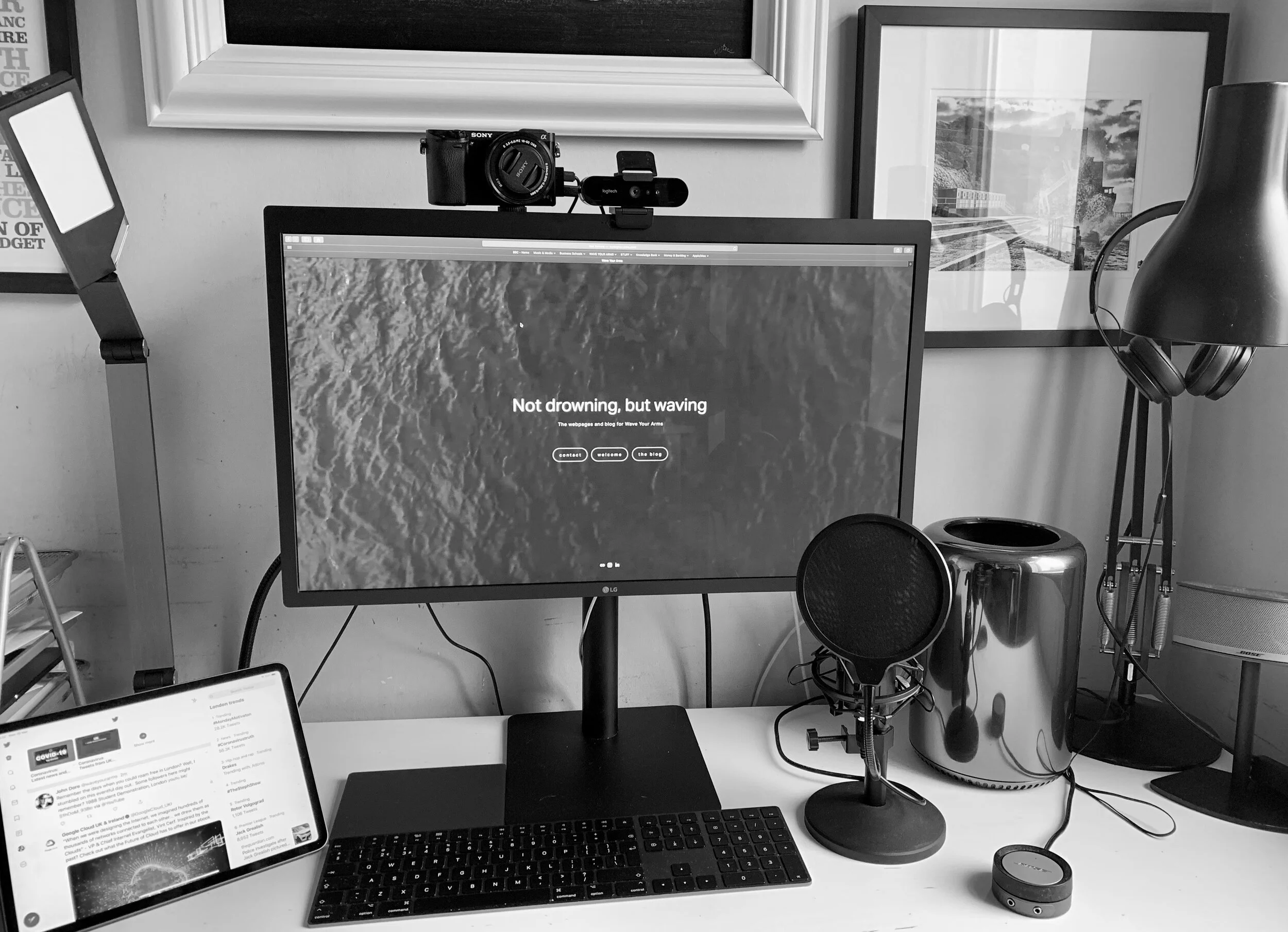
Hey, fellow lock-downers! So, this is the set-up. Nine days into a very British style lock-down and the people at Amazon Prime and eBay have delivered the goods. Thanks guys! 4K video streaming, Cam Link for mirrorless HD video, microphone, white light, Green Screen (behind me), OBS software, Final Cut Pro (on free six month trial) and a large enough stash of Wagon Wheels to keep me satiated until we get released, or not. The ambition is transition from writer and ‘real world’ facilitator to online content creator and virtual facilitator. The ambition is real. The technology is willing, though the flesh is weak.

Now I have always loved the sound of my own voice (it seems), but that was me, subtly radio-miked at a conference, or recorded by some distant camera crew, prowling the hall. On the headphones, I sound like I’m hosting a Darts based quiz show in 1983. But worse, the 1080p 60fs white lit image is staring back at me from three feet away, like an over-wrought version of self that is hard to deal with and so I remain hesitant to share. Yes, in the future (which started about two-weeks ago) all business meetings will be conducted in this way. We won’t put up with shaky poorly lit images and 240p low latency Zoom calls. We will literally want to see the “whites of their eyes” with such clarity that we can glimpse beyond their lines of ageing and into the very depths of their virtually hosted soul. Not surprisingly then, the top tip on using Zoom is to find the button wonderfully called “Touch Up My Appearance”.

The online adventure begins. The kit is in the place. I have an iPad app that maps out over the 13 predicted weeks of lock-down, a Production Schedule covering half a dozen video ideas, commentaries, reviews, interviews and features. I have watched some great stuff already done by others. Some content creators make the unboxing of a new pair of trainers look like a Christopher Nolan film. Soft focus, transitions, motion graphics, dynamic captioning reflecting the real-time commentary from the live stream of subscribers. Thankfully, that is the bigger next step along a journey only tentatively begun. For today, the challenge is to be able to not look at the screen, but at the camera! To stare into the middle distance through a pinhole viewfinder, with engagement and warmth, morphing into the best virtual version of myself. But the temptation is too great and I catch sight of my recorded self there; my eyes suddenly refocusing. I’m sat straight, looking back at myself, grinning inanely, like I’ve done all my life, but just never seen it before. The future then is much like the past, just captured and shared with a higher density of pixels.

Hope means we should get busy living

The world is in lockdown. The old order of things now suddenly dangerous, or illegal. Simple pleasures like lunch with a friend, or a walk in the park are deemed a potential hazard to others. It’s time for reflection and patience, not anger and rebellion. My guess is that we will get a mix of the two. And the outcome will be better or worse depending on which instincts win, no matter what law makers rule. The worst thing it seems is not the sense of disruption to the here and now. Outside the privileged first world we live in, few of the troubles we currently face would be deemed sufferance. The worst thing is the lingering worry and endless uncertainty. When will this end? When will things return to “normal”? The predicted days turn into weeks, turn into months and now, perhaps, the reality will be many years of restrictions and disruption.

The thing to not lose is all sense of optimism and hope. There’s nothing naive about seeing some glimmer, the green shoots, the daffodils, the acts of kindness, the re-connection with loved one’s we’d normally neglect in the hurriedness of being busy busy busy. Regrettably, I am sure I will return here on the Corona topic. I am also sure others will be way more articulate than me on a topic I struggle to properly comprehend. So I’m thinking about hope - and what that means. As the escaped prisoner Andy said to his friend Red in The Shawshank Redemption: “Hope is a good thing, maybe the best of things and no good thing ever dies. I hope this finds you well. Get busy living.” JD

I've just been disrupted within an inch of my life

BLIMEY!  I’ve just been disrupted! Overnight, I have become like Blockbuster, Kodak and the diesel engine car.  

Screenshot 2020-03-15 at 19.16.53.png

Just eight days ago, I began a quiet Sunday morning opening the 100th Edition of the Senior Executive Programme. This is LBS’s flagship executive development programme, which has been running for some 54 years. We had 36 senior leaders from around the world, who had braved some of the emerging Covid-19 concerns and headed to London. Eight days later, I sent the participants home as Italy, Spain, Saudi Arabia and others confirmed they were closing their borders, quaranteeing millions and creating a societal “lock-down” to combat the spread of the Virus. Today, it went into full maddening free-fall like something in a disaster movie. As someone smart once said, “you could not make it up”. London Business School is essentially closed. Some courses continue online, but the degree students have stopped coming to campus, the Custom clients have stopped running programmes and the Open programmes have been crippled by last minute cancellations. It has been, not to put too fine a point on it, a bit shit.

So, yes - now home and still reeling, it seems the joy of face-to-face live interactive learning for executives will be put on hold for some time to come. My guess is threee months. My fear is six. If it’s longer, major Business Schools and Universities hosting international cohorts will probably close or mothball operations for years.

The immediate reality is that Learning Directors (like me) will need to find new “cloud-hosted” rooms to facilitate, new kinds of wand to wave and new elbows to (virtually) bump.  I need to pivot fast. Next week I am re-branding myself as an exciting new YouTube Leadership guru! So, from now on I will be sharing my pithy podcasts on strategy and disruption from a comfortable ‘man-cave’ bunker in suburbia. Expect nostalgic stories about my past life, where I led senior cohorts of leaders who would come together from all over the world, connecting, high-fiving, drinking too much and talking nonsense into the early hours. 

I will be using a plethora of motivational “hashtags”, using "memes" [whatever they are?], “bigging-up” stuff and doing “shout-outs” to other online "influencers", choking the local broadband with 1080p monologues on the biggest paradigm-shifts I’ve thought up that morning. 

I ran my face global 'strategy workshop’ in 2005, somewhere posh, in Geneva. It’s been an absolute hoot. I have loved every minute of it. I never believed though that the concept of a “leadership workshop” would - within just a few days – become not just remarkable, but be regarded as dangerous, risky and (in some countries) be banned by law!

Extraordinary times. Now there’s perhaps a topic for my first Podcast?

How wonderful arguments can lead to better outcomes

I was recently asked to share some thoughts on the topic of “cognitive diversity” and the business benefits of diverse views in teams. It struck me, some of the dumbest decisions I have seen at work have been driven on a single-minded determinism that pursues a course of action without genuine consultation, engagement and certainly not, dissent. When was the last time you had a real, deeply felt debate - a “row” even - at work about a project, decision-point, or strategy? In my view, those genuine debates are very rare indeed. Opinions often vary hugely, but are seldom openly shared. Elsewhere, Amy Edmondson and others have talked about the importance of “psychological safety” as an enabler. For me, the crucial ingredient missing is not lack of alternative perspectives, but leaders who actively seek them, relish the work-out a good argument provides to any dilemma, and then continue to cherish those who offered disagreement.

Anyway, herewith some thoughts on why encouraging “wonderful arguments” [a phrase memorably used by Steve Jobs] can lead to better outcomes.

How wonderful arguments can lead to better outcomes

Good decision-makers in business are invaluable but are seldom profiled or celebrated. We too easily skip past the genius of Jeff Bezos’s parents, supporting their son’s decision to quit Wall Street and lending him the money to set up an online bookstore. Jack Welch’s gaze was famously fixed on value creation, but perhaps his masterstroke was in mandating executive development at a dedicated facility in Crotonville and deeply embedding the “GE Way” for decades. 

jobs_sculley.jpg

These stories are interesting, but it is the terrible decision-makers who fill the column inches and case studies of a business world illuminated by the wisdom of hindsight. Two different stories provide some memorably bad decisions that can help us feel better about our own trivial mistakes.  

In 1985, the Apple Board backed a tumultuous decision by its CEO John Sculley to oust visionary founder Steve Jobs, precipitating a decade of faltering innovation and uninspiring products. Jobs went on to co-create Pixar and created an animation movie industry now worth billions of dollars. Jobs returned to Apple in 1997 and the rest, as they say, is history.  

Of course, with hindsight, the decision by Sculley and the Apple Board looks foolish, as Sculley himself admitted some years later, regretful that he and Jobs had not been able to find a different outcome.  

The risks of single-minded determinism

Another extreme example of a bad decision carried through as a result of single-minded determinism comes from the world of financial services – perhaps unsurprisingly. 

In early 2008, Royal Bank of Scotland had more than £2.4 trillion of assets on its balance sheet – higher than the GDP of the whole UK. It was the biggest bank in the world. Its CEO at the time, Fred Goodwin, led RBS’ rapid growth, physically elevated and remote from his 200,000 staff, in an extraordinary office on the ‘pent-house’ level of the corporate HQ. If you were able to get an audience, reportedly you weren’t suffered for long, with Goodwin famously making decisions within his “five-second rule”.  

Of course, with hindsight, Goodwin may now regret his decision a year earlier to bullishly overpay for the Dutch financial services group, ABN Amro, which left the group bereft of capital and then helpless amid a global financial meltdown. A year after the ABN deal closed, the bank was bailed out in October 2008 at a cost of £45 billion to the British taxpayer.  

A Financial Services Authority (now the Financial Conduct Authority) report into the downfall of RBS in 2011 highlighted Goodwin’s “assertive and robust” management style as a problem for senior colleagues. Ironically, while asking for evidence of the RBS Board’s challenge to Goodwin’s dominance, the same report also highlighted the regulator’s own timidity, deploying only junior staff to review governance at the bank. 

Actively seek diverse perspectives if you want to win

Resolving the thorny dilemmas that arise in pursuing a new strategy, executing a plan, or leading change tend not to be epoch-making binary decisions, but finer margin calls, requiring careful judgement. They rely helpfully on gut feeling, but also on good data, critical evaluation, impartial advice and a practiced wariness of the ‘bias’ traps of confirmation, escalation and commitment.  

Most of all, good decisions are best not taken in an echo chamber of nodding assent, but among diverse colleagues who feel able to challenge the way we see the world.   

The best results arise from teams which harness a mix of skills and a diversity of minds. This is a broad assertion and difficult to prove across the panoply of decisions in complex organisations. Also, of course, leaders can vary and improve their decision-making approach with experience. But we can use small experiments to illustrate problem-solving failings using business games, simulations and management tests.  

A favourite of mine is a well-worn test we use with senior audiences in our Executive Education programmes at London Business School. We ask them to work in competitive teams, each challenged to exactly replicate a fabricated product, against the clock. The twist is that only one member of each team, at any one time, can actually see what the product looks like. Good dialogue, consensus and collaboration then become key.  

As the deadline approaches, smart decisions about the build process, materials, colours, form and dimensions become increasingly crucial.  

Some teams fail the task, give up, or query the process and the available resources. But we also clearly see and unpack some useful learning from those teams who are successful.  The heroes in the exercise are seldom those who charge ahead with a confident strategy, executed at speed. Often those teams miss the vital clues around them and the alternative solutions, particularly those within their own team. We observe that the best performing teams have leaders who pause and check with others. 

It may be surprising to hear that often the quietest, least assertive team members (who perhaps have a better sense of design and the creation process) are often the ones who shine. The team leaders who actively consult and listen most carefully, are often the ones who win.  

Have ‘wonderful arguments’ for best results

Consulting and active listening do not seem to have been the leadership style at Apple and RBS. Goodwin was reputably "somewhat cold, analytical and unsympathetic" in his manner and while he may have sought other’s views, it could have been that his ferocious reputation meant views he didn’t want to hear were seldom volunteered.

At Apple, there were clearly differences on strategy between Jobs and Sculley, though many of the documented disputes seem to have arose from a clash of personalities, notably Sculley’s exasperation with the “mercurial” behaviour of Jobs.  

Long before Sculley arrived, Jobs had a reputation at Apple for being a “control-freak” unable to let go of the details. Walt Mossberg (veteran American technology journalist) asked him if his people were ever willing to tell him he was wrong. Jobs said, “Oh, yeah, we have wonderful arguments...if you want to hire great people, you have to let them make a lot of decisions and you have to be run by ideas, not hierarchy. The best ideas have to win, otherwise good people don’t stay.”  

The original decision to hire Sculley was Jobs’ own. Following his own beliefs, he exited when Sculley’s manoeuvres within the Boardroom trumped his own “insanely great” ideas. 

Three top tips for thinking differently about getting others involved in decision-making

  • Seek diverse ideas from across the whole organisation.

It sounds obvious but the occupants of the Executive Floor are unlikely to be the sole arbiter of good sense in an organisation. Actively seek out views from those ‘distributed leaders’ who deeply understand the organisation and its dynamics. Seek diverse perspectives that are not normally heard, contrarian and counter intuitive.

  • Seek diverse ideas, generationally.

You may already have ways to encourage your new graduate recruits, or other employee groups, to share their ideas. But every year, an increasing proportion of your audience will not be people you will ever meet at your workplace. So how do you capture the views of the retired, a burgeoning economy of shoppers, browsers and social media users? 

  • Seek diverse ideas, with the whole internet in mind.

Harper Reed is a tech entrepreneur and was Chief Technology Officer for Barack Obama's 2012 re-election campaign. He says we should radically stretch our thinking about how we go about seeking diverse views in a digital world. He famously said: “Products are now for the internet and the internet is a hyper-diverse place. And if you don’t have a team that represents that diversity then your products aren’t going to be any good.”

A version of this article appeared on THINK, the thought-leadership journal for London Business School in March 2020.

The strange death of the inspiring workplace

Constant Change, by TONy CRAGG at ONE CHURCHILL PLACE

Constant Change, by TONy CRAGG at ONE CHURCHILL PLACE

In the early 2000’s, I had the best job in the world. Nothing could top it. I was working on a project team with some brilliantly talented people to commission, design, project manage and fit-out a new global HQ for the Barclays Group. The CEO’s brief was “create the best building of its type in the world” and we went on one of those crazy trips to the US and Europe to see other marquee global head office buildings. We met the teams who designed and built them and then hired the very best developers, architects, interior designers and workplace planners to take us from a “hole in the ground” to cutting the ribbon in about 38 months.

The team worked with HOK, a genius workplace thinker called Dr Frank Becker, we hired Jack Pringle (who became President of RIBA) to plan the space and design the interiors and he brought in Martha Schwartz to design five interior garden spaces for connecting, collaborating and entertaining. The CEO, Matthew Barrett, opened One Churchill Place in 2005 and I had the pleasure, privilege and life-changing opportunity to own the work stream where we invested in five major modern art-work commissions to bring some colour, creativity and wonder to the meeting rooms and office spaces. I spent some time with the greatest living British artist Tony Craggs in Wupertall while he created a signature piece called Constant Change for the building entrance. If you roll forward from those halcyon days to 2020, then the idea of spending over £200 million on the fit out of a million square-foot skyscraper probably now seems bonkers. In fact, the whole idea of a company having an Office, let alone a grand palatial and light-filled “World Headquarters” probably sounds so twentieth century, it would never now get the go-ahead.

So, just this week I was in an online discussion about the death of the office and, in particular, the increased rarity of that precious resource: a dedicated “Meeting Room”. I remain hopeful that the Barclays building has not yet been ruined, but elsewhere offices have gradually morphed in the last decade from owned, serviced and valued corporate destinations into something very different indeed. For many of us, it’s been a gradual degradation. Corner offices were the first to go. Then printers. Then ALL offices. Then “allocated” desks. Then Meeting rooms. Then the bookable “hot desks” simply became spots for presentee insomniacs. Then open plan spaces were turned into collaborative “hubs” with dehydrated pot plants and tired looking bean bags. On-floor kitchens have morphed into shared printer rooms, sans paper. Canteens were leased as “franchisee opportunities” and coffee became £4 a cup. And then WeWork bought the building and an allocated chair became £250 a month + VAT, though the lobby area was transformed into a convivial bar, with cold beer on tap, so we can network with others in the building who, like us, had no where to actually meet, sit or work. The Office as was is now like a fondly remembered Sony Walkman. A treasured thing of the past.

Perhaps the answer is to follow this change trajectory to its ultimate conclusion and simply skip the nostalgia of the office as ‘place to work’....and we should simply just meet in a good pub...and stay there?

Bring back the Kings For A Day

Imagine The Smiths reforming? Marr’s guitar rings out again as Andy Rourke and drummer Mike Joyce play This Charming Man but wait, there’s no Morrissey? The Police return to tour with Copeland and Sting, but no Andy Summers. The Jam without Weller? Rush without Peart? Well that kind of reunion suddenly happened and then stopped happening this year and I’m still reeling. Be reassured, I’m not thinking of the extraordinary dumping of Lindsey Buckingham from Fleetwood Mac (replaced by Crowded House guy). The musical reunion of the year happened somewhere just off the M4, was momentarily, life-affirmingly wonderful and yet mundanely dispiriting at the same time.

In late 2018 two members of “the greatest British band since The Beatles” went back on the road and played music not performed together live since the early 1980’s. Grown middle-aged men wept. XTC, Swindon’s finest, nearly together played again. Colin Moulding and his ex-XTC bandmate Terry Chambers formed “TC&I”, released a four song EP and played a handful of shows in some dreary Arts Centre, near Cheltenham.

I fancifully imagined the duo teasing a deliberately low-key warm-up for one of those “Earth-Aid’ style mega-gigs of 20 years ago, where Pink Floyd, or Led Zeppelin, or Gabriel-era Genesis would magically hug again, kiss and make up on stage, in front of 80,000 people, while their accountants and off-shore tax advisors toast them from the wings. I dreamt of Moulding playing the intro to Ball & Chain…and there, out of the smoke stage left, would stride Andy Partridge, bald head, manic teeth and ch-chopped bar chords. Shane Meadows would be in the shadows making the ‘come-back’ film. The obligatory tour of provincial towns would follow.

But no. It now appears that the TC&I project was demised almost as quickly as it appeared, as Moulding has decided to spend another twenty years out of the limelight with his family. Meanwhile, Andy Partridge lost his marbles in a horror to end all horrors shit-storm of nightmare public rows (on Twitter), locked himself in his Shed (literally and metaphorically) and has not yet come out. I both love and fear for Andy and want nothing more for him than to be stupidly happy again.

Listening today to XTC, they still sound extraordinary. Thirty years ago, Partridge was John Lennon to Moulding’s McCartney. As a song writing duo, Partridge and Moulding had all the invention of the early 1970’s Beatles, armed with riffs and melodies and hooks, and strings and brass, and astonishing bass lines and thunderous Drums and, to their left, their very own George Harrison on electric-twelve strings, Dave Gregory. Their song-writing wit and invention has seldom been matched since - though maybe Rotheray and Heaton of The Beautiful South come close .

I do not pretend to be an expert on XTC but plenty are and they have created some marvellous routes to find out more. There are some fascinating books of archives, interviews and curious stories produced by XTClimelight.com. You could start there, or you could simply find yourself a friend with one of those a science-fiction-amazing new Vinyl hifi systems, and play Nonsuch or Skylarking and just immerse yourself in the wonder that is pure pop genius. I watched a video recently where some tech wiz from Canada tested a $34,000 sound system with headphones that are called The Abyss. The quality was so good it made him cry. If I had access to that I would put on the opening of Apple Venus 1 with those ugly cans attached to my head and hear that arrangement. Such is the demand for the music to be rediscovered as amazing, there has been a lot of “re” going on, with much of the XTC back catalogue now remastered and reisssued, with some albums ”5.1 re-engineered” by Steven Wilson. Other than Trevor Horn at his zenith (and there’s a Blog topic for another day on that man) then I cannot think of a better musician to blow dust off the tapes and make Wrapped Up in Grey, or Great Fire, or King for a Day sound any better. It seems with the TC&I false start and Mr Partridge’s current hobby of writing Christmas songs for the surviving members of The Monkeys (I honestly jest not) we will never see a full XTC reunion.

We’re left with them, as they were in the past. Kings in their day.

UPDATE. 06 March 2020.
Terry Chambers recently announced that TC&I was defunct but that he would be touring in 2020 with a new band EXTC, performing a full set of classic XTC material, much of which has never been aired live. Terry has joined forces with TC&I colleagues Steve Tilling (vocals, guitar) and Gary Bamford (keyboards, guitar, vocals), plus Matt Backer (vocals, guitar) and Ken Wynne (bass, vocals).

EXTC apparently “comes with the blessing and support of Terry’s former XTC bandmates Andy Partridge, Colin Moulding and Dave Gregory”.

Thought Leadership - a different point of view

8581059753_1a3d884b52_b.jpg

The temptation is always there to ubiquitously share your brilliant insights, research, thought-leadership and points of view. But for recipients, this approach is more likely to create more annoyance than increase engagement.

Maybe a counter-intuitive approach might work? How about: less content shared with fewer people, with the intention that they might share with fewer still? You’re busy, so we came up with eleven quick ideas to make your thought-leadership more effective.

  1. Encourage sharing, not reading.  Brand building used to be about what people said about you after you left the room. Now it’s about what people share about you (often while you’re still in the room). So, make it as easy as possible to share something smart and intelligent about you (no logins, portals, paywalls), just simple sharing, even if the first recipient has not even read a word of it.  

  2. Be quirky, or nerdy, just not plain clever. The counter-intuitive, contrarian, quirky, memorable and surprising idea is better territory to pursue than the empirically proven, peer-review journal treatise.  You may have an evidential data set that would impress the brains at Deepmind but that doesn’t mean it will still stir a thumb into liking or sharing. 

  3.  Don’t distribute it widely; distribute it carefully.  Consider sharing less content, with fewer people, who you encourage to judiciously share with fewer still.  Make it rare and precious.  

  4.  Press send less often. Remember the scene in Harry Potter when hundreds of owls deliver the same message to Harry over and over through every possible route?  That’s what it feels like to be a recipient of thought-leadership.  Be considerate.  

  5.  Filter more, create less.  Stress test your best internal ideas and thought leadership materials against the very best you can source in the market. Quality usually wins. So edit and filter rigorously.  Less is more always.  

  6. Think about the kids. Before you press send, ask someone who is 19 years old to read it. You may already suspect that the piece is too long.  It is. 

  7.  Don’t create and then circulate white papers, like ever.  Share the executive summary page only, with simple clear graphics and then head off and enjoy lunch. 

  8. Share stuff with the least number of recipients you dare to restrict it to. Seriously. As few as possible. So commit as much energy to rationalising, segmenting and selecting only those who should receive your content, as you do to curating the content itself. (Please then be prepared for your digital Marketers to howl, as their ROI is likely to be all about the quantity of views, not the quality of recipient). 

  9. Make your followers feel like thought-leaders.  Scrutinise who follows, likes and shares your thought-leaders and return the favour.  What goes around…   

  10. Sharing UPWARDS is the goal. The ‘holy grail’ is the content piece that is shared upwards with the MD, the C- Suite or the CEO. Go on – accelerate your career: encourage cluttering the boss’s inbox. 

  11. Get a room.  As the UK Editor of Wired magazine said: “We used to produce a magazine and put on the occasional event. Now we manage a complex events and conferencing business, which allows us to continue publishing a print magazine”. Content is no longer enough.  Live events, with you in the room, still rock.

What Just Happened? A year in review.

at the beginning of 2018 I decided to write a screenplay about the american poet e e cummings. there is something about his relentless use of lower case letters…but, as the year closes, the screenplay remains (more or less) unwritten. the idea is still wrapped in self-bemusement, procrastination and obfuscation. I need cummings' muse (he may indeed have had many) or I know, someone else will write the story soon and I will one morning spit-out my coffee, when I read the release notices and see the proposed cast list. as someone very wise once said, "there are only two great ideas at any point in time, and someone is already doing yours”*

ok, that's enough lower case for now.

In January, I discovered The Name of the Wind by Patrick Ruthfuss. I completely and utterly devoured that book and the second novel in the series, The Wise Man's Fear. About two thousand pages in a week. At its centre, an enigmatic hero called Kvothe. The story remains one of the single best things I have ever read. The third instalment remains unfinished, or at least unpublished, with the writer keeping his audience holding its breath for Kvothe's fate since 2011. Agony for them and, I am sure, and a nightmare for Rothfuss, who still stoically takes the stage at fan conventions and speaker engagements and helplessly blinks into the middle distance light, as the inevitable question comes, "Patrick, when will Book 3...?"

Much of the early part of the year was spent on Virgin Trains (who subsequently became renamed some bizarre acronym due to losing their license) heading Northwards and Southwards to see my son play rugby league. En-route, I read The Magicians (by Lev Grossman) and it's sequels, equally stunned by how amazingly Narnia-esque and inspiring it was, and then completely befuddled, disappointed and made cross by how terribly awful it became. [Warning - please do not go near the SciFi TV adaptation of the same.] Subsequently, and due to regular spells of over-running engineering works, I have also re-discovered Frank Herbert, Philip K Dick, Isaac Asimov and some strange Chinese Science Fiction that’s kind of weirdly addictive and calming.

Up North, I spent much time in Leeds. I never tire of the Harry Enfield line about the City. "Don't talk to me about sophistication, I've been to Leeds." I have written else where on here about growing up in its poorer City cousin Bradford and how that chip on the shoulder weighed heavy on its proud neighbour and perhaps, still me. I read an announcement that Channel Four is moving to Leeds, after a competition against some other cities. A competition between places - not people, like ‘The Apprentice” I guess, but with more bus route maps and commercial real-estate considerations. Well done Leeds. I have no idea what this means in terms of upping the sophistication levels of Leeds, but it’s a blessing for Yorkshire after so many media jobs were staffed with London based commuting luvvies over in Salford Quays, Manchester. Away from Leeds, I spent time in May in San Francisco, Silicon Valley with work and then recharged with good friends in LA. In San Francisco, a City I struggle to love, I met up for a drink with someone I had not seen for 28 years which was rather cool and made the trip and my mood much better. But not as good as the mood created by a few days by a pool in Rappallo and a trip through the Cinque Terre. Wow, I love Italy. Meanwhile back in Blighty, people I know and love have suddenly and without any warning become 50 years old. Thankfully, I have an enchanted mirror in the loft so I fear not the clock, but hell - what just happened? Fifty years?!

On the theme of sophistication, the new Bridge Theatre, as a venue/bar, was immediately much loved, but the productions have been mixed. Julius Caesar - a Trump themed warning about self-proclaimed demi-gods, power politics and social disintegration, rang loud and true from the off. Subsequent productions were less than fab. My Name is Lucy Barton was two hours too long and I only lasted half an hour of something new but awful by Allan Bennett. Elsewhere and, strangely, more uplifting than Bennett’s play, I did see a 79 year old Ian McKellen carry Cordelia on his back in King Lear. The year was book-ended by the gorgeous and blub-inducing A Christmas Carol at The Old Vic.

I went to C2C again and discovered Ashley McBride, Lukas Nelson and Lanco. I used to feel obliged to go for my daughter. I now rather fear my eagerness to go along is greater than hers. Other music highlights of 2018 are numerous. Spotify now rather handily counts up and tells me exactly what has had the most ear-time in 2018. I will fess up to Animal Kingdom (now defunct?), Icarus, Field Music (Open Here is song of the year), Cherry Ghost's cover of Finally, Gas Coombes, Kacey Musgraves, Beirut, Kurt Vile, Let's Eat Grandma, DIIV, Deerhunter, Hookworms, Sunflower Bean, Razorlight (what a return to form!?) and the completely wonderful Courtney-Marie Andrews, who just gets better and better. On a rockier front, I am still reeling from the news about Rush's Neil Peart, who according to Geddy, has not "just retired from Rush, but retired from drumming". A loss to a noble profession. [See below for another drummer of note]. Wild Beasts from Leeds (see above) also made the town a little less sophisticated and split-up, but leaving us with All The Kings Men - still one of the all time greatest live sing alongs.

Onwards

In September my son stopped playing sport in Yorkshire and began studying at Jiao-Tong University in Shanghai. I’ve been to the City a number of times and enjoyed the place hugely without speaking a word of Mandarin. Now my son haggles over cab prices with the best of them. In October I GOT EXCITED about writing again, but the real-world quickly reared into view and Final Draft remains an expensive luxury application in a dusty desk-top folder, with its improved functionality un-touched. Which is the point at which these essays usually look to the future with some renewed ambition to pick up the pen again. My twitter feed is full of “a page a day is 2 1/2 screen-plays in a year” encouragement nonsense. I remain and perhaps will always be, stunned, amazed and humbled by those who graft and craft stories, write and re-write, then plough through 10 or 20 or 50 drafts before submitting their script and waiting and waiting. I know I should dare re-join them in 2019.

"anyone lived in a pretty how town, with up so many bells floating down…summer, winter, autumn, spring, he danced his didn’t, he danced his did…"


* according the Wikipedia: the cummings’ poem was adapted into a short film by George Lucas, of ahem, Stars Wars fame.

JD

PS. On a MUCH brighter note, if you ever wondered why rock n’ roll has stopped the world from going nuclear in the past 60 years, please do take 30 seconds to watch the sheer unbridled joy, skill, professionalism and commitment of the drummer from The War on Drugs in the mid-section of Under The Pressure, which builds, snaps and rocks up another musical chunk of wonderment for the good people of London. I will leave you with that moment.


Landing a space rocket on a floating barge made to look easy

IMG_0978.jpg

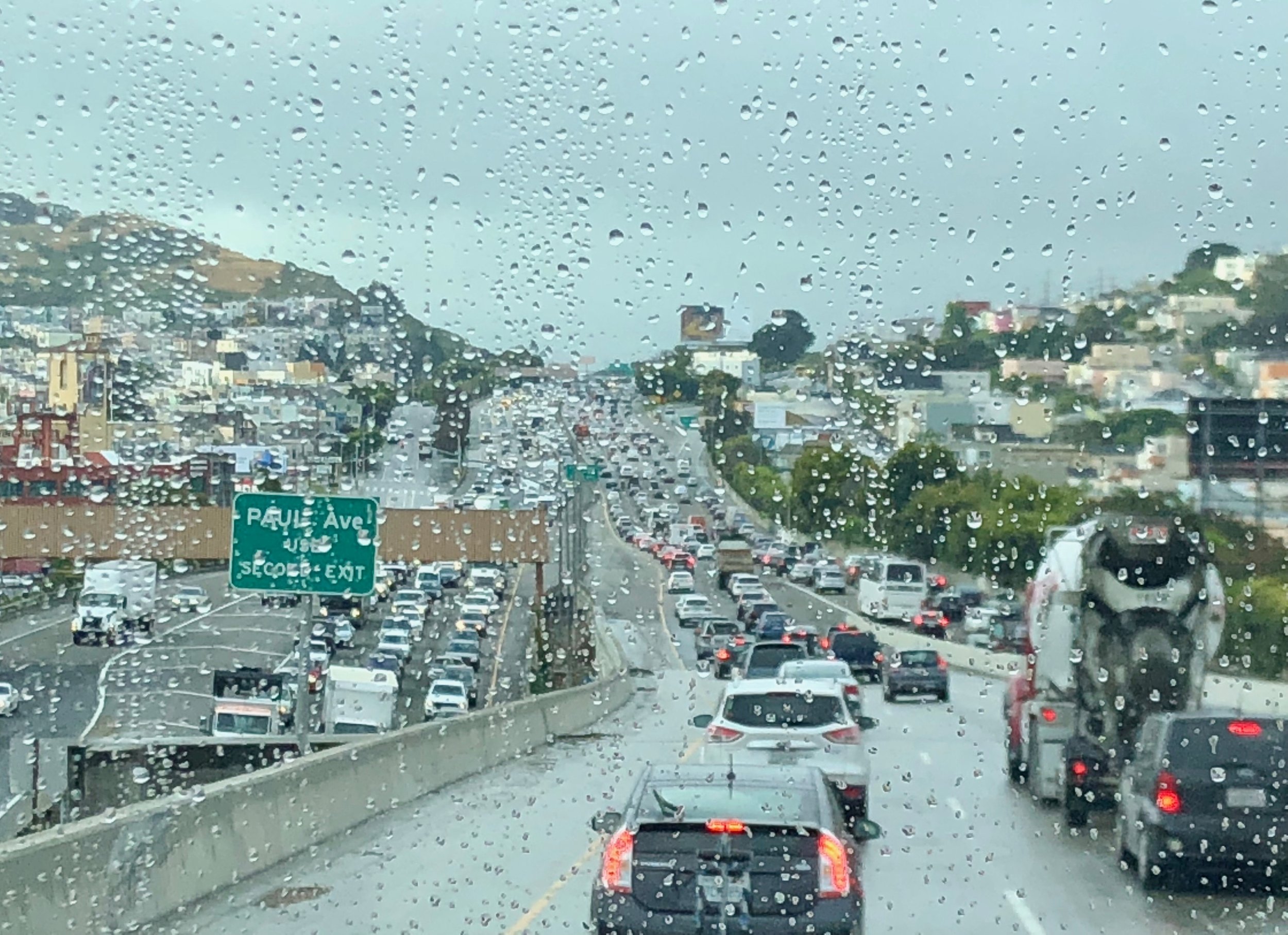
I am just back from San Francisco. I had the Mamas and The Papas in my head as we drove in from airport. Indeed, as the drizzle blew off the bay, all the leaves were brown and the sky was suitably grey.  We passed the vast billboards for tech companies advertising their latest gizmo to other aspirant unicorns who had bought billboards on the same freeway.  The place was full of surprises: but not the surprises I’d expected.  We explored the city, piers, cable car, Union Square and cheered an 8:5 win for the Giants.  All seemed good with the world in northern California, except for the weather.  But then we began to look closer.  

Travelling into the Valley, the traffic on the 101 was cliche-bustlingly terrible.  The Google buses had removed their branding, but not their bike racks.  Their glass was now tempered and tinted, so rocks thrown from bridges wouldn't hurt the engineers bused in from cheaper postcodes.  Guided by LBS’s Peter Hinssen, we visited Sunnyvale and Palo Alto, met four start-ups, four scale-ups, a health focused accelerator, a VC, and enough guest speakers to make our heads burst!  We stood outside the the Garage of Hewlett and Packard, the “birthplace” of Silicon Valley from ninety years earlier. As we returned from the Valley, we gawped passing lovely Atherton. Bloomberg had just ran a story highlighting Atherton as the second richest postcode in the whole of the USA, with the average income over $1.5 million according to analysis of 2015 IRS data.  Atherton's neighbours include Stanford University and Menlo Park, home to Facebook and various fast growing tech companies.  Some of the best paid people with the smartest minds in the world are concentrated in a small town of just 7,000 people.  

As the evening mist and breeze chilled the air, we returned to our central San Francisco Hotel, just a few hundred metres from the Crystal Meth fuelled fringes of the City.  The place may zing with the vibrancy of the new digital, tech, AI, Blockchain economy, but in its homeless problem surfaces a grim reality of lives lived without a social safety net.  There are approximately 7,000 recognised homeless in the City, and more arrive each day. Strangely, no one asked me for money which made the plight even more unnerving.  

The bay area is a region that created the most valuable enterprises on the planet. Not content with making our shopping, browsing, entertainment and connected lives so much better than we could ever have imagined a decade ago, firms like Apple, Google, Facebook, and others, continue to innovate brilliantly and make their own "dent in the Universe."  Elon Musk is rightly revered for the smarts he has brought to market from payments, to electric cars, to now sending rockets into space with SpaceX; landing them upright, intact and re-usable on a floating barge in an ocean hundreds of miles away. 

In the comfort of the cool Hotel bar we mused.  How can a place of such imagination, innovation and creativity; a place imbued with values of diversity and respect for difference, also be a place where its wealth creators drive each day over free-way bridges, under which citizens die?  Many of the wealth creators like Gates and Zuckerberg have committed billions to charitable causes, research and philanthropic endeavours all over the world.  But in this beautiful City, the homeless still shout at themselves, lost, confused and deranged.  We had no easy answers and there have been thirty years of well intentioned public policy attempts and initiatives to help alleviate the problem.  But maybe if the uber-smart and visionary minds nearby can land a reusable space-ship on a floating barge, perhaps some corner of those minds could be briefly applied to solving the issue of 7,000 homeless?   


Shakespeare, Trump and the liberal elite collide

IMG_0394.jpg

There are some things I simultaneously love and loath about London.  On the one hand, it draws in a world of talent, entrepreneurs, creativity, smart ideas and investment capital.  It literally buzzes, zings and pops at its best. 

But is also excludes through its unfettered acceptance of Wonga; building soulless elevated housing estates for millionaires who don’t live here, blighting the riverside, the posher postcodes and the leafy boulevards heading West.  It’s increasingly depressing to wander along the Thames in the heart of the City and gaze up as gilded cages, empty, bought off-plan remain unoccupied, except for a bored front-desk concierge, dreaming of elsewhere.  Here, some of the greatest views in the world are created for the interior designer to briefly enjoy, before they finish, click-off the lights and leave the space devoid of life and love and mess.   

When Sir Christopher Wren rented a house on Bankside (a few yards from the re-built Globe Theatre) he could open the curtains and through the sash see a new Dome come to fruition, topping St Paul’s like the St Peter’s of Rome he had in his minds-eye. Now that beautiful home stands in the gloomy shadow of perversely constructed steel and glass dystopian towers named without irony, NEO; hundreds of apartments and penthouses in four Pavilions, rising in sequence with unparalleled views towards St Paul's.  The nicer flats here cost about £22 million. The ugliness of NEO is only relieved by a nearby 50-storey aberration of sense and taste; an architectural horror called One Blackfriars.  It bulges at its mid-rift like the belly of an avaricious property developer devouring his lunch with the city planner nodding his assent without conscience.

Further West, the re-built iconic chimneys of Battersea Power Station are repainted.  The vast development at least has mixed use in its masterplan (and a new office home for Apple) but, as all South-East Train commuters already know: the trackside Dogs Home contains more of a sense of life and hope than any of the completed mega-apartments.  These are vacuous gloomy spaces, preposterously gold coloured, and already, with a faint smell of deathly regret hanging from their balconies.  Nearby, the new American Embassy will open at Nine Elms, its staff soon navigating the echoing streets of what has been redesigned as the single most soulless neighbourhood in the world.  As the playwright Beckett might have put it: “Nothing comes, nothing goes, this is awful”.   Donald Trump has condemned the place and refused to cut the ribbon.  Even a mad, egotistical, self-anointed Emperor might be worth hearing on this one.  

Heading back East, we stumble upon another new shiny London District bizarrely called More London.  Directly opposite the Tower of London, the Mayor's Offices stand empty in the evening, heroically sustaining the planet by being as perpetually dark as doom and unused for two-thirds of the year.  The hastily landscaped park nearby is cut across with a narrow path from the foot of the extraordinary (and mainly empty Shard) into a new riverside area called Potters Field Park, with stunning views of Tower Bridge. 

And here, beneath yet more empty apartments we finally found life.  And not just life, but creativity that lifted the soul, talent and imagination and wonder, in a new subterranean home by the river. The new Bridge Theatre is a wonderful place. Founded by Nicholas Hytner and Nick Starr, The Bridge is a new 900-seat auditorium and is the first wholly new theatre of scale to be added to London’s commercial theatre sector in 80 years.  Designed by Haworth Tompkins Architects (winner of the 2014 Stirling Prize) it is a wonderful industrial, yet comfortable and intimate space.  It was heaving as we arrived for a new production of Julius Caesar.  The bar is terrific, with open space and friendly staff.  We headed downstairs, not sure what to expect with a modern staging of an unloved play.  

The production is unlike anything I have ever seen before.  The staging of Shakespeare in the round is not new, but this was built with the technical hydraulics and sound effects of an action movie.  Caesar arrives like Trump at a rally, but with a real rock band playing Seven Nations Army as if it were Corbyn at Glastonbury; the extraordinary cult hero/enemy instantly enthrals and divides, whatever your politics. The crowd on the floor of the theatre are sold hats and t-shirts for the Trump-like Caesar, about the be crowned by Mark Antony (David Morrissey).  It is the liberal elite versus Trump, the Brexiteers versus Remainers but with machine guns and agitators stirring the crowd. 

Brutus (Ben Wishaw) cannot stomach the coronation of this self-serving “god” and stirred by a brilliantly played Cassius (Michelle Fairley, also brilliant as Catelyn Stark in GOT) the conspirators gun him down on an elevated throne and dip their hands in his blood to ensure their treachery is known and celebrated.    Of course, it goes horribly wrong for the conspirators from there on. While we sat a little back from the tumult stunned, some down in the "pit" throng literally fainted amidst the blood, the guns and the spit words of dread and doom.  Powerful. Awesome. Extraordinary.  Life-affirming good and relevant theatre.  

We stumbled out into the deathly quiet streets, with hundreds of others, still buzzing. 


The Guys from the South Country

I'm just back from the Old Vic.  An irregular venue for me, but also one where I have experienced the three best performances of my too-irregular theatrical-going life.  Nearly twenty years ago, Kevin Spacey enthralled in The Iceman Cometh and I am not sure anything else he did in his time as artistic Director at the theatre company was ever as good.  He was again superb in 2006 in A Moon for the Misbegotten, but no moment in that tale really compares with Spacey's first performance as Hickey, striding into a bar of apathetic drunken losers and somehow, fleetingly, giving them a sense of hope. [Ed, its always a shocker to now think back and know and have not known then, 14/11/17]

A decade later, I literally crumbled at the end of Groundhog Day, Tim Minchin’s re-imagining of the film originally starring Bill Murray. The show premiered for about six weeks at the Old Vic in 2016 and is now a massive hit on Broadway.  There was a nice moment on social media this week when Bill Murray went to see the new show, not once, but twice on successive nights.  He simply had to see it again.  I would love to do the same. 

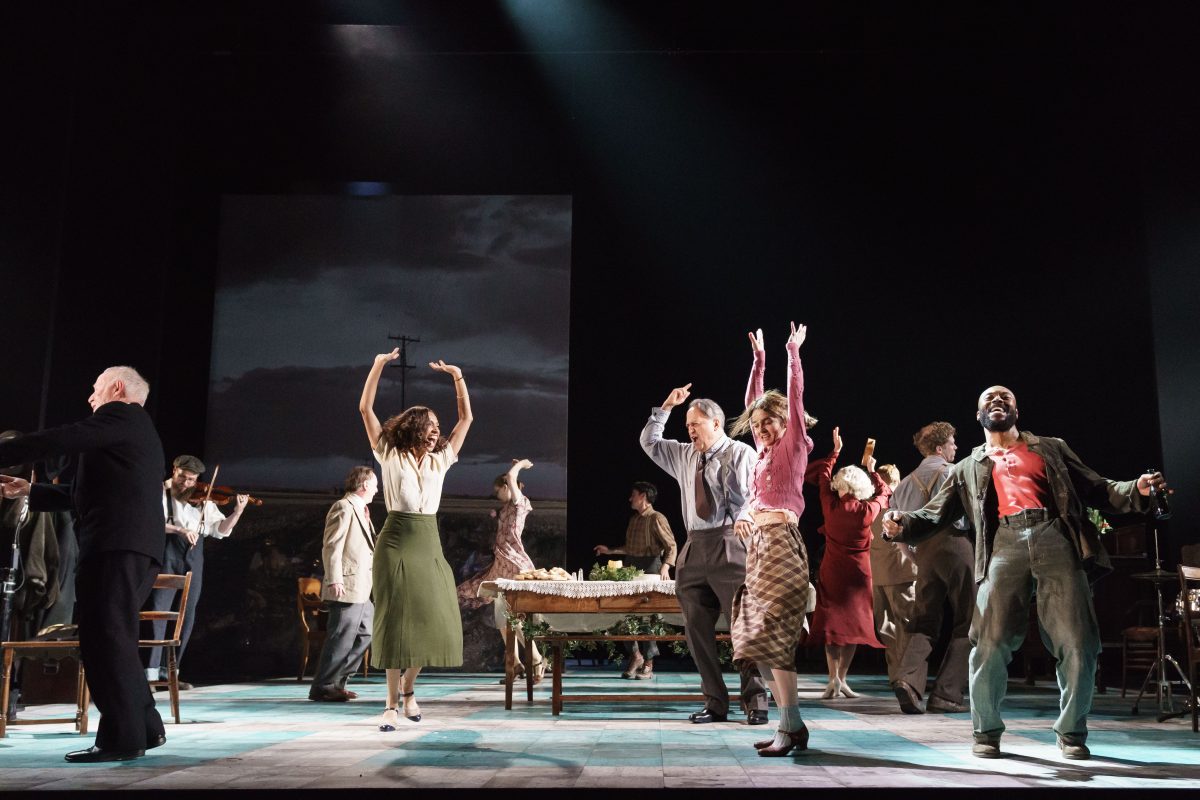
Then this week, in a familiar seat, just behind an admired theatrical Lord of the realm, the open stage is slowly illuminated for a new show called The Girl from The North Country.   Written and directed by Conor McPherson, it looks and feels like the same territory as O’Neill’s The Ice Man Cometh.  An appropriate déjà vu moment then as the lost, the drunken, the delusional, the criminal and the unfortunate huddle together in a guest-house on the cliff-edge of Depression Era Minnesota.  The background is briefly narrated and closed by an elderly Doctor and the misfits struggle to find a way out of a spiral or debt, guilt, lies and deceit.  The moments of hope are all expressed in song, mining the vast Bob Dylan song-book, not to create some happy-clap-along Musical (the West End is already full of Kinks, Four Tops, Beatles and Jacko pastiche shows) but as moments of heart-felt expressions of hope, or anger, or even, love. 

The songs don’t mirror the narrative, nor drive it forward in anything other than an imperfect, strange, evocative way.  And Dylan's words are sung by all the cast.  By an escaped-convict pugilist, or a miserable lady in red while smashing her drum-kit, or, by Elizabeth [played by Shirley Henderson] an ethereal demented wife of the guest-house proprietor.  Twenty actors and musicians share the weight of the tale, but also grab the limelight for a fleeting moment, as they make you catch your breath at an arrangement of Like A Rolling Stone, Forever Young, Sweetheart Like You, or (I am convinced I heard a verse of) All Along The Watchtower.   A standing ovation followed and the press reviews have all been five star.  It's wonderful and raw and, like Once (reviewed on these pages before) it stays with you long afterwards.  

This week travelling South West to the Levellers' Beautiful Days festival, we took a diversion or two, looping off the A303, dodging Stonehenge via Salisbury and around the hills and dips across through Dorset and into Devon. Suitably, the car speakers thumped and hummed with the songs of XTC.  As we drove through green hills, another pastoral paradise was evoked by their Apple Venus and earlier albums; songs filled with misfit characters and criminals, the lost, the disillusioned, the unloved and the conscripted.  The journey and the time passed quickly in the company of the wit and artistry of Colin Moulding and Andy Partridge’s wonderful songwriting and the playing and arrangements of Dave Gregory, Terry Chambers and others.  Which got me thinking about a new possible writing project.  One not set in Minnesota, but maybe somewhere around Swindon, at the end of the last century, and it would end Stupidly Happily.      

You can get a glimpse here of The Girl from The North Country here.  

Unleash the Power of Networks

Networking at a Conference: your idea of heaven, or hell?

Networking at a Conference: your idea of heaven, or hell?

Few of us truly relish networking.  We may well recognise the importance of a good network, but maintaining and growing one demands time, effort and some adapted behaviours that can exhaust the introvert and be tiresome even for the most outgoing amongst us.

We might enthusiastically sign up for conferences, events and seminars with the hope of connecting with key influencers and valuable business introducers. But we often leave deflated, feeling that the time was wasted.  Or worse, we depart clutching a random bundle of business cards but then never re-connect with their owners.

Some try to concentrate their efforts online. By creating topical thought pieces, regularly sharing smart ideas and hungrily aggregating Twitter and Linked-In followers, it has never been easier, it seems, to build an impressive looking network.  Unfortunately, this approach alone cannot create the sort of 'sticky' relationships made offline.  Put simply, a 1,000 connections on Linked-in does not a true network make. 

Our approach, called Four Routes to Growth, is very simple and, if pursued with some discipline, can be enormously powerful. 

Evaluate your current network  

The first step is to evaluate where you are now in terms of your existing network, focusing on close personal relationships, current and former colleagues and valued clients. Many other networking methods start similarly and encourage you to compile a list of everyone you know.  Without too much trouble, you can export this from Linked-In, Facebook, various unlogged business cards and your online address book.  You may quickly amass hundreds and hundreds of names. 

The crucial step though is to evaluate what you see.  You might grade or rate or colour code the list from close to distant, accessible to inaccessible.  Think deeply about how close and how engaged you would describe your contacts; particularly the ones you rank towards the top of your list.  Critically appraise how effectively you have maintained, developed, supported and regularly embraced (in all senses of the word) these key relationships in recent times.  This might give you some pause for thought, but even if it does, don’t be deterred.  

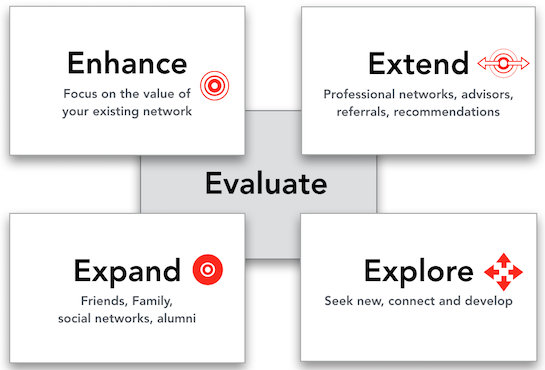
Your available time for networking is always going to be scarce, so depending on your specific goal, you need to dedicate your time to a particular strategy.  This is what we call the Four Routes to Growth: Enhance, Expand, Extend, and Explore. 

Route One: ENHANCE your most valuable relationships

The most valuable network we have is not the one “out there”, but the one we already have.  We call a renewed focus on this group Enhance.  For many good reasons you may find that the number of professional relationships that you describe as very close is relatively small, but where these relationships do run deeper than the merely transactional or ephemeral, they can be powerful places to start your networking adventure. You may feel that you already have a good foundation on which to build, in which case we advocate that you actively seek to expand-out from that core. 

One of the exercises we undertook with the RMs was to get them to think about how well connected they were with one another. Many had been colleagues for years but seemed to know surprisingly little about one another away from their role, or position within the firm. Few knew their colleagues’ personal stories, skills or life-experiences.  Surely an opportunity missed?

Route Two: EXPAND your existing network

We most naturally expand our networks through deeper relationships with those we already know.  We meet their life-partners, families, colleagues, clients and suppliers.  These connections can generate huge value.  Expanding your network does not have to be a lengthy expedition, but can be best initiated from within your closest and most accessible relationships.  It’s a tongue twister, but it’s not what you know, it’s who you know knows who. 

You may feel that some once warm contacts have now cooled because of time, or distance. There is no manual that can make you pick up a phone or reach out to a once close contact and make that relationship ‘click’ again.  But if you are hesitant about their likely response, consider how you’ve responded to a suddenly revived contact from the past?  Perhaps a former colleague, or an alumni contact from University? Our guess is your now 'distant' contact will respond in much the same way as you. 

Route Three: EXTEND your reach

Extending your network means moving into a space that is unfamiliar and more difficult to access.  The good news is that the starting point will still often be from within your existing professional network, so ask to be referred.  Sales professionals spotted this sometime ago, as did recruiters, estate agents, dentists and (increasingly) the algorithm built into the API in your social network of choice.  Of course, it’s now easy to blithely share, like and recommend a contact online and such virtual endorsement of real-world connections can be useful reciprocal stroke or nudge. Ultimately though, the development of valid strong relationships takes time and real-world personal attention.

Network relationships, as opposed to network contacts, emerge more naturally from conversations which extend beyond 140 characters.  Initiating these conversations may initially seem alien, pushy, perverse or uncomfortable, but all are par for the course in your goal of extending your network.  The key seems to be to seek opportunities to “pay forward” your own energies and ideas as an offer of help to others. 

Route Four: EXPLORE new networks

Here is realm of the adventurer, the conference junkie, the traveller, the explorer. If you are seeking opportunities to radically develop a wholly new branch of your network, then perhaps Exploring will take the majority of your time and stretch you more than any other route. But cultivating a number of radically new introductions can transform your network.

A close colleague of ours spent pretty much every spare hour of his life developing new contacts and relationships that would help him find ways to pitch his entrepreneurial venture.  He's now CEO of that venture.  Also, don’t be phased by the discovery of the huge numbers of others exploring the same route as you.  In 2010 I managed to secure accreditation to attend the film market at the Cannes Film Festival. My badge gleamed in the sun as I approached this hard won opportunity to press real film-making flesh and sell my script.  14,000 others were accredited in the same market that week. 

So you’re an Explorer, picture yourself in the coffee area of a busy conference, head down, scrolling through emails on your phone.  This does nothing to extend your network or your well-being.  In that moment, think how you can be helpful to others, not how the others in the room can help you.  As Keith Ferrazzi wrote in the wittily titled, Never Eat Alone: “Successful networking is never about simply getting what you want. It’s a sort of career karma, too; how much you give to the network determines how much you’ll receive.” Turn off the phone and however clumsily, turn to someone and say hello. 

Applying the Four Routes to Growth

If you like the framework and have stayed with me this far, then the following plan of attack might work for you.

Look at your schedule for the next six months and no matter how busy you feel you will be, commit to finding 100 hours to developing your network. You may legitimately wish to pursue all four routes simultaneously but the more clarity you have on your specific networking goal, the more likely you are to smartly prioritise one route.  The crucial element is to plan your time strategically and not to underestimate the commitment needed.  If 100 hours seems a lot, remember Malcolm Gladwell's dictum that it takes 10,000 hours to become truly accomplished in any pursuit.

If your network goal is a new position or promotion within your existing firm, then your approach may focus on Enhancing and Expanding your core network of internal relationships.  If an external career move is planned, you might focus your time on Extending your network, using existing Enhanced network as a safe and confidential route to secure informal conversations.  Exploring is by its nature more time consuming and more variable in its outcomes.  Enhancing may seem more passive and less exhilarating but over time may create a foundation for unlocking Extended networks. 

Evaluate where you are at the outset and re-assess again at the end of the 100-hour campaign.  Take time to review how your network has evolved.  What did you learn about yourself, your aspirations and the people you met on the journey?  What opportunities did your campaign throw up for you to recommend or refer others?  If you feel underwhelmed by the outcomes, did you really invest the time that was needed? 

A final thought

ThE FOUR ROUTES TO GROWTH MODEL

ThE FOUR ROUTES TO GROWTH MODEL

Groups we have worked with have embraced the approach and used it well. We observed though that their commitment to the process was reinforced because they shared their personal goals and strategy with one another. Those conversations seemed to be the catalyst for some early momentum. So before you set out on your route, tell someone you trust what you’re trying to achieve. That might be the most valuable conversation about networking you ever have. 

Not Rotterdam or Anywhere, Liverpool or Rome. Hull.

A new EXHIBITION ABOUT LARKIN OPENS AT THE BRYNMOR JONES, HULL

Famously a curmudgeon, misanthropic and brilliant, Philip Larkin is remembered for his poetry, his complicated love life and being a Librarian. He is of a particular time and place, like a British built car from the 1970's, familiar, flawed and reassuringly drab.  Despite having all the blessings of been born in a cathedral city and then educated at Oxford, he (like many others since) only really flourished creatively when he went to live and work in Hull. The City of Hull now proudly makes claim to two of the greatest poets in the English language; Andrew Marvell [who didn't muck about at the Grammar School, securing a place at Cambridge when only 13) and 300-hundred years later, its now cherished adopted son Larkin.

But like many adoptions, not all went smoothly from day one.  Upon arriving in Hull in 1955, Larkin cheerily described it as “a hole, with witless, crapulous people" but, as the relationship deepened and the incessant breeze slowed his progress cycling the Avenues, he came to see beyond the town as a “fish smelling dump” and to embrace the place. Writing in The Whitsun Weddings, he describes arriving on a train, seeing the estuary widen, finding the surprise of large town where only "relatives and salesmen come", and undeterred, he heads out to the suburbs, beyond the fringes of the place to find a beach: "an unfenced existence.  Facing the sun, untalkative, out of reach."    Larkin stayed and over the next thirty years, Hull became home to a man who brilliantly honed his verse so that he could make a joyous wedding seem like a funeral, or a long-lost friend feel like a newly discovered ailment.  

I went to live in Hull thirty years ago this autumn and went back briefly just this month as part of the Hull 2017 City of Culture celebrations.  I drank in some familiar pubs, watched some Rugby, met some friends and even took time to explore Larkin's library.  It is extraordinary.  They have hidden all the books behind opaque sliding screens, like some post-modernist joke.  You can come in and browse, and explore: but no reading the books!  Cheery volunteers encourage you to take in the scale of the place, see the visiting National Portrait Gallery exhibition, or enjoy a double-espresso in the vast coffee shop across from the light-filled ‘willy-Wonka’ lift lobby.  Head up, take in the view, but you won’t find any books. Somehow, I felt Larkin might appreciate the efforts made since his death to keep the students' grubby fingers from his carefully indexed tomes.

In the evening, we headed out "East", but not to find Larkin’s endless unbroken view, but far far away in East Hull to see another of the City's adopted sons, Paul Heaton, play a huge outdoor gig at the dilapidated old 'Hull KR' ground.   The journey there and back was like a scene from a Cecil B. DeMille movie.  Some 27,000 of us tried to make the same journey with the help and support of half-a dozen shuttle buses and the disinterest of the world's worst taxi service.  Hull has two unique civic aspects that are hard not to notice.  It has white phone boxes that nobody uses and it employs the world's worst taxis.  These are strange elevated vehicles with no windows, designed it seems, to ferry you home patched-up from A&E late at night but constructed so that you remain oblivious to where you might be going.  Suffice to say, on the day when this City of Culture hosted a Bowie-inspired retrospective, lefty-chanteuse Charlotte Church, outdoor theatre in Newland Avenue, Wigan v Hull FC, an auspicious Philip Larkin AGM and a major 'festival' style outdoor gig in the City, the taxi drivers collectively shrugged, headed to West Hull, lit a fag and determinedly stayed there.

Clearly the City of Hull has a new pulse and a new confidence, proclaimed high on billowing flags lining the broad newly-pedestrianised streets. The University (the city’s biggest employer) has grown immensely with the area near Pearson Park adorned with an array of deli's, trendy wine-bars and cool shops to quench all thirsts and tastes.  Culture is a powerful lever that other cities, notably Liverpool and Newcastle, have worked successfully and it would be petty to quibble with the cultural ambition Hull has surfaced this year.  But somehow, the City still doesn't seem to have enough people who move here and stay, or new capital or jobs, or investment.  Even its grubby neighbour Doncaster seems to have poked two fingers towards the city.  When you catch the train to Hull, the platform you board is bizarrely numbered “0”.  So if you are a relative or salesmen (or student), you have to leave for Hull from Platform Zero.

Heading back on the train to London, someone suggested that the likely next candidate for UK City of Culture would Coventry....Larkin's birthplace.  Like Hull, a proud town bombed heavily in the War, restored with vigour and still resolutely unfashionable.  Sounds the perfect place.     


Are Thought Leadership Events Worth The Money?

Think about the last time you received one of those emailers for the very latest “thought leadership” seminar.  An opportunity to spend anything up to £2,000 a time seeing the latest greatest most cutting edge thought-leadership speakers at some cool conference with an even cooler name: WeirdZeitgeistTED XYZSmorgasbord, or Whatever.  Tempting and sounds interesting you think, but is it really worth it?  

There has been an explosion of formats, venues, providers and sponsors of ‘thought-leadership’ events.  Joining the established conference organisers, a great plethora of publishing companies, technology start-ups, professional associations and recruitment consultancies are striving to land chunks of a global market.  While many content creators provide online access, there still seems to be a growing demand to actually be there, in the room.  

In the UK, the Marketing Society showcase big name speakers and captains of industry at mega conferences, flashy awards dinners and ‘masterclass’ seminars. The annual Festival of Marketing in London flies in former Space Shuttle commanders and Mindfulness experts to help you realise your strategic ambitions.  These events cost almost a £1,000 a ticket.  In April this year, PR Week announced that their 2016 event would last 4 [yes four] days at £1,800 a ticket.  Your CEO has to stump up a six-figure "patron fee" to get an invite to (real) TED or sell and lease-back their corporate headquarters to secure a place in a seminar room at Davos.  

So are these events worth the money?  Well if your objective is not just personal content consumption; but thought-leadership sharing, then we think so.  If you need an opportunity to collate and share smarts back with the leadership team at HQ, then some are better than others.  One of our favourites in the UK is WIRED which is wonderfully inventive and eclectic.  At £2,000 a ticket for a two day conference, the attendees have either had to personally dig very very deep, or play a blinder with their line-manager to get the ticket cost picked up by their employer.  But because of that, you get a rather extraordinary group of people in the room.  Nor just presenting, but in the audience. 

THE ACHILLES HEEL

So, come on!  I get the sharing smarts bit, but are they really worth the money?  Well if your objective is broadening your network, then we think not.  Where these conferences consistently fall down is in their stated objective to enable networking.  It's the number one registered "reason for attending" by delegates.  It is seldom fulfilled.  

The reality is that networking does not magically happen just because the event producers have allotted a time slot for "networking" in the programme, or (as I saw recently) by placing a banner above the coffee station with the words NETWORKING AREA emblazoned in 4000pt Helvetica Bold.   

Networking needs guidance, facilitation, encouragement and needs to be designed into the flow of the programme, the seating arrangements, the layout of the room, the content design and most importantly the philosophy and mindset of the hosts.  Otherwise, delegates seeking real networking opportunities will move onto event formats that have more connectivity and ambition than a series of well-lit predictable presentations and panels.  

The real value of these events is found, not in the content, but in connecting the people in the room.  The events organisers and programme designers who get this aspect more right than the current underwhelming norm are the ones most likely to get returning delegates, recommendations and referrals.

Marmite and the Leadership Conundrum

The recent Marmite spat in the UK between behemoth retailer Tesco and mega consumer goods producer Unilever was entertaining while it lasted. Something that 50% of the population can’t stand (I am referring to the potent yeast extract, not the supplier or seller) was briefly unavailable on Tesco's website and the national press, BBC and social media went mad. A combination of pre-Brexit sterling devaluation and a proper negotiation ‘ding-dong’ (a technical term in supply chain management) meant that 50% of toast spread fetishists might have to go without Marmite the next time they ordered an online delivery.

Half the country were outraged, half the country were not bothered.  Such polarity seems to be a feature of so many other aspects of business and political life. The margins might vary “at the margins” so to speak, but political choices are becoming more and more like Marmite conundrums and just too close to call. 52% voted to the leave the EU, 48% wished to remain.  This month, after over 50 years of civil warfare in Columbia, a peace deal was rejected by the "no" camp: 50.21 percent to 49.78 percent, a difference of less than 60,000 votes out of a total of 13 million. The US Presidential election in 2000 between Bush and Gore turned on the narrowest margin of victory; less than 0.5% of the votes cast. Half the country thought that cool, half the country thought the world would subsequently melt.  The US seems again split down the middle on a choice between two different flavours of Marmite: both loved and loathed, but equally unpalatable to the impartial observer (if anyone can be impartial about the leader of the free world). These fine margins between yes and no, between right and left, form a good tradition between love and hate, which got me thinking about leaders [and in a more profound way than just an excuse to reference a Tinita Tikaram hit from the late 1980’s].  

The Marmite Leader

There are of course other manifestations of this Marmite schism and one which is commonly experienced by almost all here reading Linked-In: The Marmite Boss. We’ve all worked for him or her.  Revered or revolting, depending on where you stand. The Marmite boss might attract fierce loyalty from some and deep antipathy from others. Some managers inspire the spirit, some devour your very soul. The Marmite boss seems to be equally spread across organisations both large and small and even the most ambitious and creative teams seem hampered by a leader who is seen by half the team as Voldemort and the rest as The Chosen One. I once worked for one boss who would fire contract staff while bouncing a tennis ball off the wall above their heads while the boom-box under his desk played Another One Bites The Dust. I couldn't bear to be in the lift with him for 40 seconds. A close colleague thought "he rocked" (citing a whole range of a qualities I had been oblivious to) and went on to work for him for nearly a decade. Depending on their perspective, some would swim the ocean for him, while others considered defenestration.  

What then is the secret ingredient to good leadership?  What makes a manager a good or a terrible one?  Searching through a few models of leadership I think I may have stumbled across a few clues. A leadership professional recently merrily shared on here the requisite qualities needed for good leadership.  All ONE HUNDRED of them! Another detailed the matrix of "31 essential qualities". Another a coherent argument for a mere "24 levels of leadership". This complexity might explain why some of the numerous ingredients just get badly formulated in the mix; that the supposed qualities that make some leaders inspire, make others a disaster to be around.

There are innumerable models of leadership; synthesising the various tendencies, qualities, preferences and behaviours that become the "hero" or the "psychopath", but the key seems to be in how you personally respond to these; how they accord with your own values, outlook and point of view. It's complicated and hard sometimes to discern good and bad.

Perhaps it's a matter of taste?

Groundhog Day and the Curse of a Nostalgic Youth

A friend of mine recently asked me enigmatically: whatever happened to the rhetorical question?  And it was with this feeling of slight befuddlement that I flicked through the ‘Culture’ pages of my leviathan Sunday paper and looked ahead to an autumn of arts, films, events and music.   The highlight for me stood out like a momentary beacon of pulse enhancing anticipation….the prospect of seeing Groundhog Day at The Old Vic.  The Bill Murray film was fun, but I wasn’t sure about the prospect of a repetitive film on stage, let alone as a musical.  Still, the team behind this created Matilda and the songs are by Tim Minchin.  Matilda truly sparkled so I have high hopes and the recent preview at the Southbank awards (see film below) of Seeing You whetted the appetite.  

But why should the thing looked forward to most in the future, be a remake of a half-loved thing from the past?  There is something extraordinary about the films, music and experiences of our youth that still keeps a powerful hold decades later.  In a way its magical, but its also somewhat unnerving because it seems (to borrow from Blur) to make Modern Life seem a bit Rubbish.  

A nostalgia for past music events can seem almost perfectly sepia tinted and flawless.  Most of the people I work with today were not alive when Bowie sang Heroes at Live Aid.  It still gives me goosebumps.  Watching the Live Aid concert at the time it was completely possible to then watch U2's Bono pose and posture (sans shades) and not instinctively want to thump him.  He waved peace flags and danced with someone in the crowd and the band played one song for 15 minutes.  That, as a warm up set for Queen.  Kids today wouldn't get it.  

Bowie plays Live Aid.  AD 1985.  

Bowie plays Live Aid.  AD 1985.  

I recently read Ready Player One by Ernst Cline.  It's a book about the future, completely and utterly imbued with references to the past.  The mysterious Willy Wonka style tech genius who invents a virtual world of escapism is himself immortalised, not though some vast digital ecosystem, but in his vivid reimagining of the 1980’s…and the music, films, games, TV shows and garish banality of it all.  Reading Cline's book makes you dive for long unplayed DVD’s [remember those?] of John Hughes movies: Pretty in Pink, Some Kind of Wonderful and The Breakfast Club, which I recently watched again after over thirty years.  Allison (played by Ally Sheedy) says "When you grow up, your heart dies."  Al, you're wrong, or why else would these films still hold our affections, not just as curios or museum pieces?  In Ready Player One, the hero Wade resorts to trying to woo the avatar of the girl he loves by standing outside her house and holding a boom-box above his head, playing In Your Eyes by Peter Gabriel.  Kids today wouldn't get it.  

This weekend my local Waterstone’s sold several hundred hardback copies of a stage play script for Harry Potter and The Cursed Child.  The sale of several hundred hard-back books by any author is quite a feat, but hundreds in just one bookshop alone., then multiplied across the world.  Amazing.  The play is set nineteen years after the Potter books ended, condemning Harry the wizard, who defeated the forces of darkness, to become a bored civil servant with troublesome kids who don’t communicate.  Like Outnumbered, with wands.   Sourcing a ticket for the plays in London is rarer than a Hufflepuff last-gasp winner at Quidditch, apparently.  But it's not the kids haranguing their parents to buy up the stalls and the gods.  

Once you touch this sense that the best things today are recreations of the best things of your life when you were fifteen years old, then you can’t help but spot them everywhere.  Short of the Smiths reforming in 2017, then music today seems locked into a downward cycle.  The 1975 made one of the best albums produced in years, but it’s because they sound like Scritti Politti fronted by a Geordie Michael Hutchence.  Currently, the challenge for music stream providers and curators [viz Apple, Spotify, Tidal] is to "create music like it was on MTV in the 1980's", to engage millions in the discovery and exploration of new acts, who become globally huge like Madonna, Michael Jackson or Duran Duran. I am not sure they can; not because the technology is not oh so slick, but because they don't make the acts like they used to.  Apathy Killed the Video Star.  

I turn on an iPad and stream the show Billions - the newest thing I know.  Then a friend points out “its just like Dallas”.  Yep, got me there.  Replace the Texan hats and the padded shoulders for a Metallica t-shirt and swap hedge-funds for crude, and we’re back in the land of JR Ewing and the saga of macho egos at war.  Film producers scrap and scrape to connect with this nostalgic past.  They buy established assets and invest in named properties that need less development, scrambling for books, or ideas or characters that have already gathered dust on a shelf.  Occasionally they get it wonderfully right, but more often they get it horribly wrong.  I fail to see the sense in Peanuts The Movie, or the risible Dads Army, but then Spielberg re-imagines The BFG and a whole new generation of adults drag their kids along to see it.  "Look a film of a book you'll never read, but I did!"  

If you can come up with formula that connects the past with a keen sense of who you are today then it can be wonderfully potent.  Marketers, brands and start-ups are wrestling with how to bottle it, label it and get it stacked on shelves.  Even though we are surrounded and bombarded by multifarious multi-media touch-points today, I am not sure of the longevity of much of the content will be as sustained.  And in trying to get any prediction right for anything today that will resonate in the future, then maybe Minchin's version of Harold Ramis has already nailed it:  "Today I know that I know, nothing."